Does the colour of your motorcycle gear really change how easily other road users see you? We compare hi-vis and dark motorcycle clothing, explain where each works best and share practical ways to be more conspicuous on UK roads.
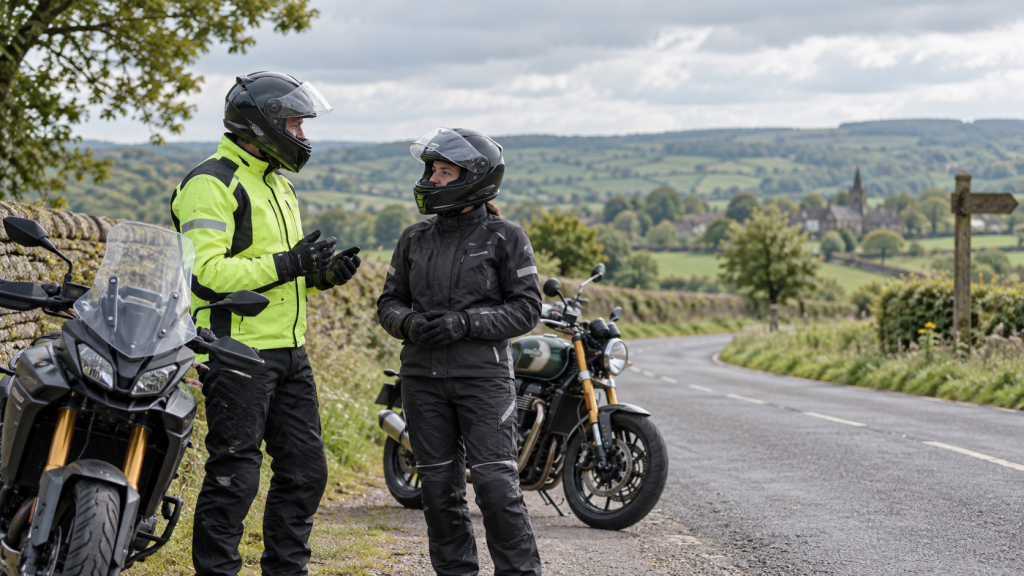
Short answer: yes, the colour and reflectivity of your motorcycle clothing can affect how easily other road users notice you. Hi-vis gear can make a useful difference in the right conditions, especially in daylight, dull weather and busy traffic. It is not, however, a force field. Dark motorcycle gear can still be a sensible choice when it is combined with reflective details, good lighting, deliberate road position and active observation.
For most riders, the best answer is not an all-or-nothing choice between fluorescent yellow and head-to-toe black. It is to build a visibility system that works in the conditions you actually ride in.
Does hi-vis motorcycle gear really improve visibility?
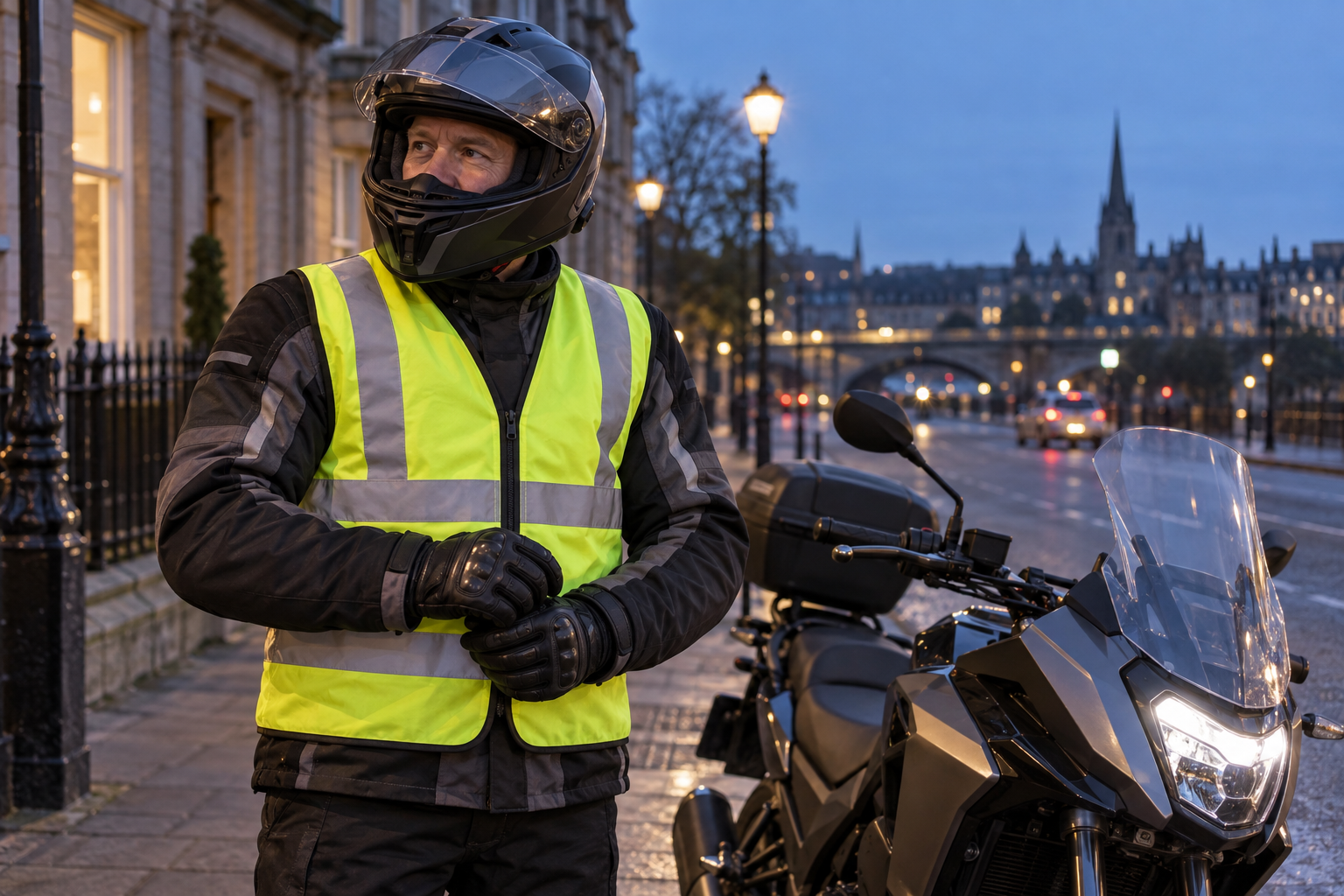
Hi-vis motorcycle gear is designed to stand out against common road backgrounds. In daylight, fluorescent yellow, lime and orange can be easier to notice than dark colours against hedgerows, grey tarmac, parked vehicles and overcast skies. That extra contrast can help a driver detect that there is a rider present sooner.
Being detected sooner matters because many motorcycle incidents begin with a driver simply not registering a rider early enough. A bright jacket or vest cannot make another person look properly, but it can improve the chance that you are noticed when they do glance in your direction.
That is why high-visibility gear is particularly useful for commuter riding, town traffic, country roads shaded by trees, poor daytime weather and situations where you are approaching junctions. It gives your silhouette a clearer visual cue in places where a dark jacket can merge into the background.
Hi-vis, reflective and fluorescent: what is the difference?
These terms are often used together, but they work differently:
- Fluorescent material looks especially bright in daylight and low, flat light. It needs daylight or another light source to work.
- Reflective material throws light back towards its source. It is most effective at night when vehicle headlights shine on it.
- Bright solid colours can provide contrast, but they do not necessarily fluoresce or reflect.
A fluorescent yellow jacket may be very conspicuous on a grey afternoon, yet its advantage fades after dark if it has little reflective trim. Conversely, reflective piping can appear almost invisible in daylight but become highly noticeable when headlights pick it out at night. The most versatile motorcycle kit uses both.
Is dark motorcycle gear less safe?
Dark motorcycle gear is not automatically unsafe, and many riders choose it for practical, aesthetic and touring reasons. Black, charcoal and dark textile kit can look smart, hide road grime and work across several seasons. The question is not whether dark gear is “allowed”; it is whether you have given other road users enough clues to see you in the environment you are riding through.
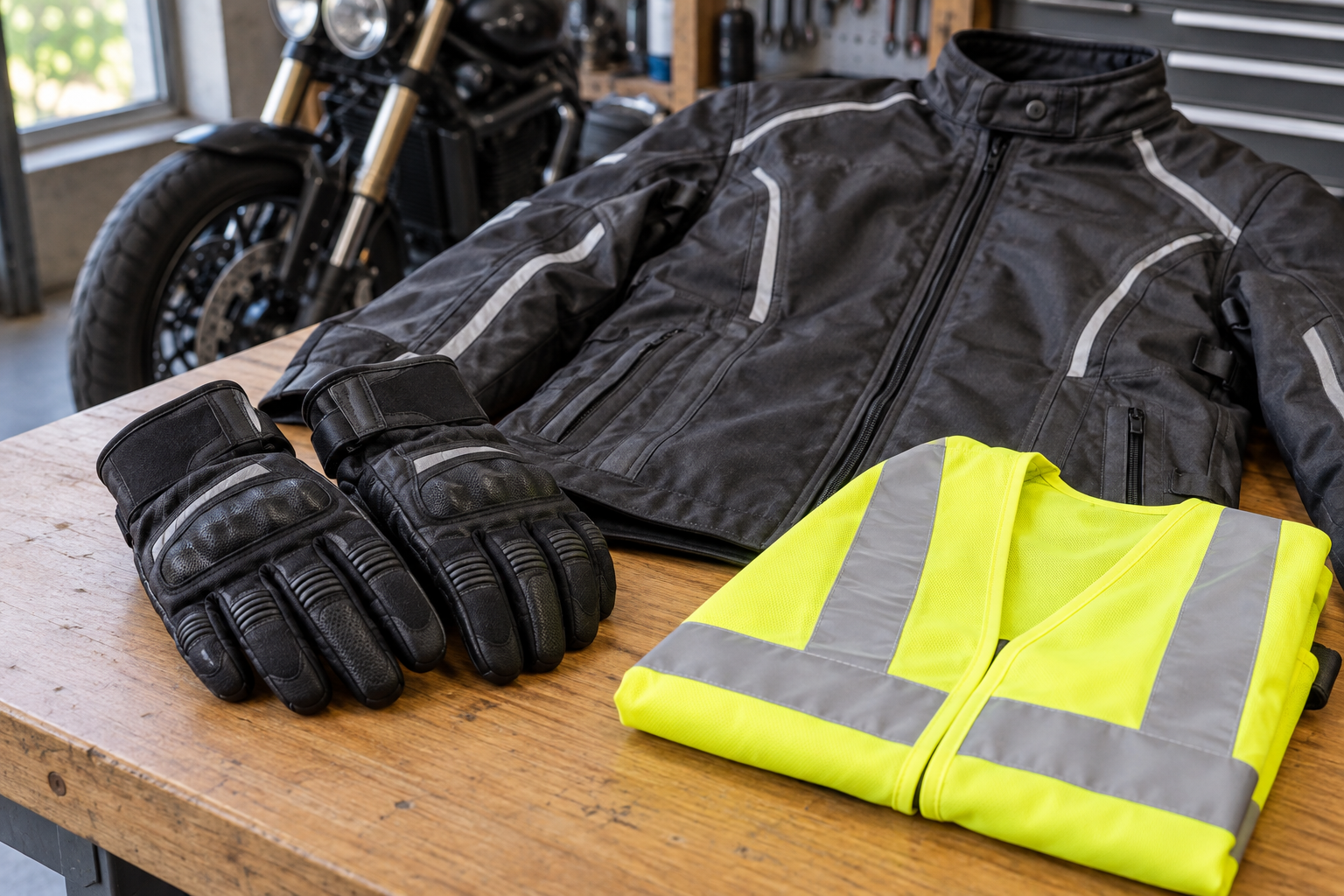
At night, a rider in plain dark clothing can blend into the road edge, hedges and vehicle shadows. In daylight, dark gear can be less distinct against a line of trees, a dark car or a wet road. That does not mean you must replace a good-quality dark jacket. It means it is worth adding visibility elsewhere: reflective panels, a compact over-vest, a bright helmet, clean lights or a more purposeful road position.
When does hi-vis make the biggest difference?
Junctions and filtering traffic
Junctions are a classic place for a rider to be overlooked. Drivers are processing road signs, pedestrians, other cars and gaps in traffic. A high-contrast upper body can help you stand out from that visual noise. The same applies when moving slowly through dense town traffic, where a bright vest can make your position easier to judge in mirrors.
Overcast days and rain
British weather has a talent for turning daytime into a sea of greys. Rain, spray and wet road surfaces reduce contrast, and drivers may be concentrating on the road immediately ahead. Fluorescent material and larger reflective areas are useful additions when the light is flat and visibility is reduced.
Night riding
For riding after dark, reflective elements deserve as much attention as colour. Look for reflective panels on the chest, arms, back and lower legs. Movement helps other people identify what they are seeing, so reflective gloves and ankle details can be especially useful. Keep the material clean: a layer of road grime reduces its effectiveness.
Why hi-vis is helpful but not enough on its own
Visibility is a shared problem: clothing is only one part of it. A driver might be distracted, looking through a dirty windscreen, dazzled by low sun or simply judging a gap badly. Even the brightest rider can be missed.
Use hi-vis as one layer of protection, rather than as permission to assume you have been seen. At junctions, watch the front wheels of waiting vehicles, cover the brakes where appropriate and leave yourself room to react. When approaching a side road, consider whether a small change in lane position will stop you sitting behind another vehicle or a roadside object.
Good visibility also depends on a clean visor, working headlight and tail light, sensible following distance and smooth, predictable riding. Nothing replaces reading the road.
A practical visibility setup for dark gear
If you like dark motorcycle gear, you do not need to abandon it. This simple approach works well for many riders:
- Choose built-in reflective details. A dark jacket with reflective piping or panels gives you a useful night-time advantage without changing your everyday look.
- Carry a lightweight hi-vis over-vest. It takes very little room under the seat or in a pannier and is easy to put on for rain, commuting or unfamiliar roads.
- Use clear, clean lighting. Check your headlight, tail light, brake light and indicators regularly. A filthy lens or failing bulb undermines every other visibility choice.
- Make your helmet part of the picture. A lighter helmet or reflective decal can help make your head movement easier to notice.
- Think about the lower half. Reflective ankle bands, boot details or trouser panels move as you ride, helping others recognise you as a motorcyclist.
What about a bright helmet?
A bright helmet can complement either dark gear or a hi-vis jacket. Your head moves naturally as you scan junctions and check mirrors, so a contrasting helmet can be a useful visual cue. It should not be treated as a substitute for the rest of your kit, but it can be a practical option for riders who prefer a subtle jacket and trousers.
Hi-vis vs. dark gear: the best choice for everyday riding
If your priority is maximum daytime conspicuity, a fluorescent hi-vis jacket or vest over your motorcycle gear is a strong choice. If you mostly ride at night, make reflective coverage a priority. If you prefer dark kit, select garments with reflective areas and keep a high-visibility layer ready for low-light, rain or dense traffic.
The most balanced answer for UK riders is usually a quality motorcycle jacket and trousers that fit properly, include impact protection and have some reflective detailing, plus a bright over-layer you are happy to wear when the conditions call for it. Comfort matters too: safety kit only helps when you actually use it.
Motorcycle visibility checklist before you set off
- Are your headlight, tail light, brake light and indicators working and clean?
- Is your visor clean and suitable for the light conditions?
- Will your clothing contrast with today’s weather and surroundings?
- Do you have reflective material visible from the front, sides and rear?
- Have you packed a hi-vis layer for rain, dusk or a longer ride home?
- Are you planning to ride in positions where other road users have the best chance of seeing you?
Frequently asked questions
Do I have to wear hi-vis on a motorcycle in the UK?
No. There is no general UK rule requiring motorcyclists to wear hi-vis clothing. You should still wear suitable protective equipment and make deliberate choices that support your visibility.
Is a hi-vis vest better than a hi-vis motorcycle jacket?
Either can be effective. A vest is flexible because you can wear it over existing kit and pack it away when you do not need it. A purpose-made motorcycle jacket may offer a more integrated fit and reflective coverage. Choose the option you will use consistently without compromising protection, movement or comfort.
Does reflective gear work in the daytime?
Reflective material is designed to return light towards a source, so it is most useful when headlights or other direct light are shining on it. In bright daylight, fluorescent and high-contrast colours are generally more noticeable.
What is the best colour for motorcycle visibility?
There is no single best colour for every situation. Fluorescent yellow and orange are widely used for daytime contrast; reflective silver or grey is valuable after dark. A combination of bright, reflective details and good lighting offers the broadest coverage.
The verdict
Hi-vis motorcycle gear can genuinely improve how noticeable you are, particularly in daylight, poor weather and busy traffic. Dark gear is not a bad choice, but it benefits from thoughtful additions. Treat colour and reflective material as part of a wider visibility strategy: maintain your lights, pick a strong road position, anticipate mistakes and never rely on another road user having seen you.
At Mallory Motorcycles, we believe the best motorcycle kit is the kit that protects you, fits your riding and gives you every reasonable advantage on the road.