The government has launched a major new consultation that could fundamentally change how we learn to ride, test, and upgrade our motorcycle licences in Great Britain.
Launched this month by the Department for Transport (DfT) and the Driver and Vehicle Standards Agency (DVSA), the consultation titled “Improving moped and motorcycle training, testing and licensing” is looking to modernise a system that has remained largely unchanged for decades.
Whether you are a learner on a CBT, an instructor, or a full licence holder looking to upgrade, these proposals could affect you.
Here is a breakdown of the key points and how you can make your voice heard.

The End of "Permanent Learners"?
One of the government’s primary goals is to discourage riders from riding indefinitely on L-plates by renewing their Compulsory Basic Training (CBT) every two years.
The consultation proposes incentives to encourage learners to take their full test, rather than getting stuck in a cycle of CBT renewals. This moves towards a system where the CBT is seen as a stepping stone, not a long-term licence.
Automatic vs. Manual CBT Restrictions
Currently, if you pass your CBT on a twist-and-go scooter, you are legally allowed to ride a manual geared motorcycle on the road.
The consultation proposes changing this to align with car licensing. Under the new rules, if you take your CBT on an automatic, your certificate would be restricted to automatic machines only. To ride a manual bike, you would need to complete a training upgrade or take the CBT on a manual machine.
Progressive Access: Upgrading Without a Test?
This is arguably the biggest news for existing riders. Since the EU licensing tiers (A1, A2, A) were introduced, moving up a category (e.g., from an A2 restricted bike to a full unrestricted A licence) has required retaking the practical tests (Module 1 and Module 2).
The consultation is finally looking at introducing Progressive Access via training.
This would mean that instead of booking another test with a DVSA examiner, riders could upgrade their licence by completing a formal training course with an instructor. This brings the UK into line with many other countries and simplifies the route to a big bike for those who have already gained experience on smaller machines.
Theory Test Changes
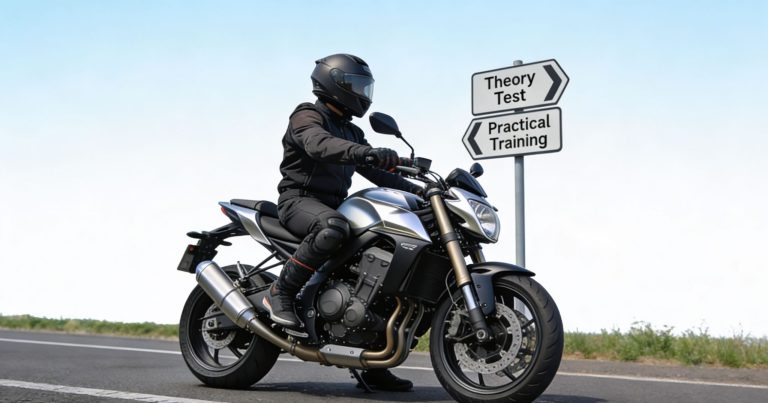
The DfT is considering making the motorcycle theory and hazard perception test a requirement before or during the CBT process. Currently, you can ride on a CBT without ever passing a theory test.
Proposals include:
- Requiring first-time road users to pass a theory test before their CBT.
- Integrating a theory course (like the Ridefree scheme) into the CBT syllabus.
Revoking CBT Certificates
Currently, the DVSA has limited powers to revoke a CBT certificate once it has been issued, even if a learner rides dangerously.
The proposals seek to grant powers to revoke CBT certificates if a learner accumulates six penalty points or is caught riding dangerously. This would effectively ban them from the road until they retrain, adding a layer of accountability for learner riders.
Why is this happening now?
Road safety is the driving force. Despite making up only roughly 1% of traffic, motorcyclists account for approximately 21% of road fatalities in GB. The government believes that modernising training – specifically focusing on the quality of instruction and ensuring riders have the right skills for the bike they are riding – will save lives.
How to Respond
The consultation is open now and seeks views from the riding public, instructors, and the industry.
If you have an opinion on Progressive Access, CBT restrictions, or how we train new riders, this is your chance to shape the future of biking in the UK.
You can read the full document and respond online here: GOV.UK: Improving moped and motorcycle training, testing and licensing